Graphic: Rise of AI Exclusions in Insurance Policies – ai created image - mrh
The Rise of AI Exclusions in Insurance Policies
From Narrow Endorsement to Systemic Impact: The Generative Artificial Intelligence (AI) Exclusion Story
Introduction
Whenever a new exclusion appears in insurance, the industry often treats it as narrow, technical, isolated and manageable. But history shows that exclusions rarely stay confined to the line where they begin. They migrate. They evolve. And they often alter expectations of coverage far beyond its early interpretations and what insurers first intended.
What we are seeing now with generative AI exclusions may be one such moment.
At first glance, these endorsements look like another underwriting adjustment — an attempt to define emerging technological risks before claim patterns develop fully. But the larger question is whether these exclusions are the beginning of a broader redistribution of risk across commercial insurance. Once AI becomes embedded in business decisions, communications, hiring, underwriting, client advice, and governance, it becomes difficult to isolate where AI ends and ordinary business conduct begins.
This raises a serious issue: If exclusions begin in one policy form, why would they not eventually influence professional liability, management liability, directors and officers coverage, fiduciary liability and even broker standard-of-care disputes?
If this occurs, we are not merely discussing wording. We are examining the early architecture of future claims disputes, future underwriting debates and future expert testimony.
This three-part paper reviews this early AI architecture and what these generative AI exclusions may mean not only today, but also where they are likely to lead next.
AI adoption has become widespread across almost every industry. Once a futuristic concept, AI has evolved into a common business tool, enabling companies to complete complex tasks in a fraction of the time it takes a human to complete. However, AI has its roots back to the 1950s.
Graphic: Generative AI Exclusions in Insurance Policies - ai created image - mrh
Let’s take a brief look at the development of generative AI.
A Historical View of Artificial Intelligence
The history of artificial intelligence (AI) begins with the groundbreaking work of British mathematician Alan Turing in the mid-20th century. Turing’s academic contributions included the concept of the universal Turing machine. This laid the foundation for modern computing and AI. During World War II, Turing explored the idea of machine intelligence, envisioning computers that could learn from experience. His influential 1950 paper “Computing Machinery and Intelligence” introduced the Turing Test, a practical standard for determining machine intelligence. In his pivotal paper, Turing introduced the Turing Test, a practical standard to evaluate a machine’s ability to exhibit intelligent behavior identical to human performance. Today’s AI experts consider his paper to be the foundation of the field of artificial intelligence.
In the 1950s, researchers developed the first practical AI programs. Christopher Strachey’s checkers program,[i] a machine that could play an entire game of checkers, and Arthur Samuel’s machine learning-based checkers system, led the way.[ii]
These early efforts were crucial in demonstrating the potential of AI to solve complex problems and learn from experience. The 1960s and 1970s saw even more advances with the development of expert systems like DENDRAL and MYCIN. These systems applied AI to highly specialized fields such as chemical analysis and medical diagnosis and showed AI’s ability to outperform human experts, although in narrow domains.
Simultaneously, the field of connectionism gained traction, focusing on artificial neural networks modeled after the human brain. Connectionist systems use artificial neural networks with layers of interconnected nodes that continue to improve through model training.
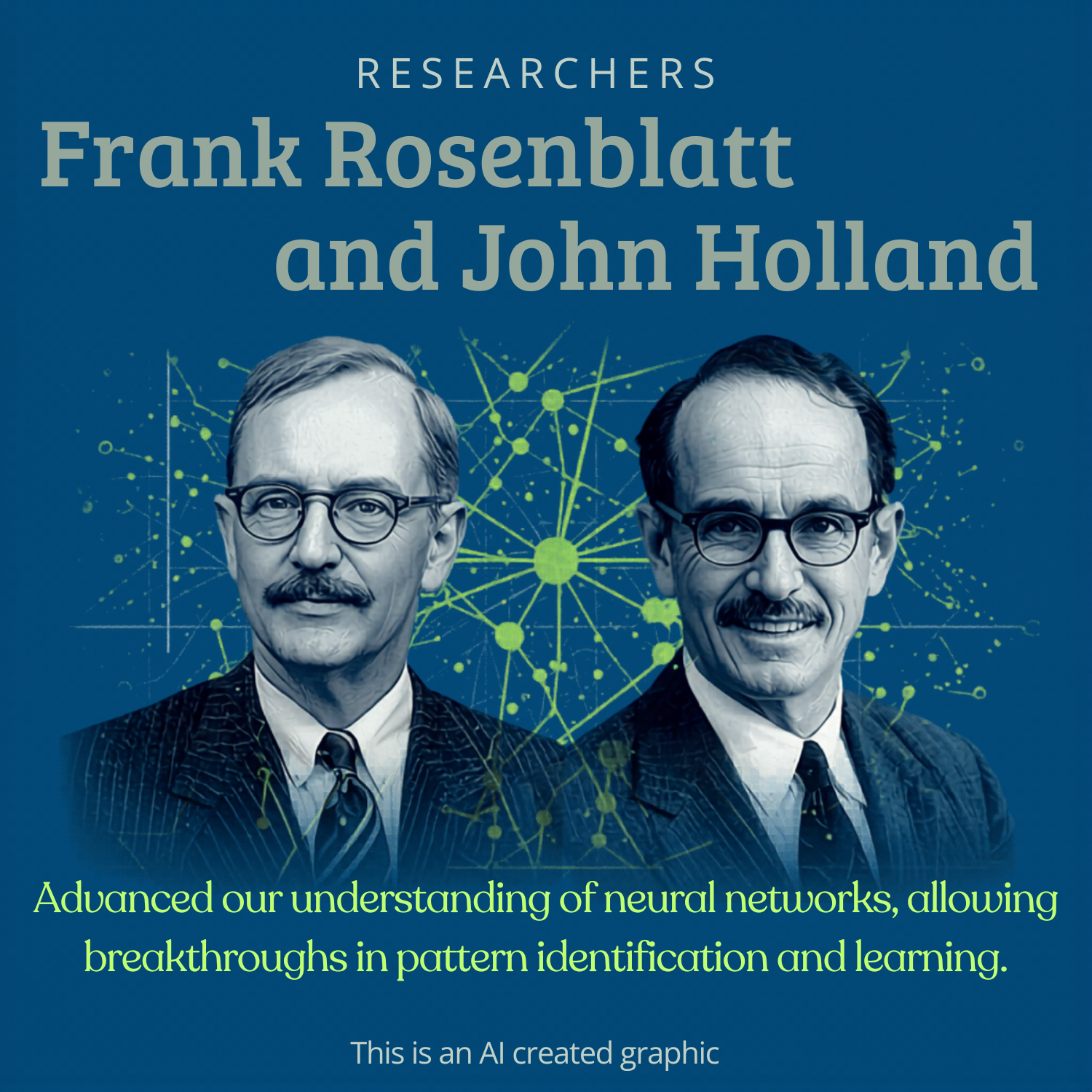
Image: Researchers Frank Rosenblatt and John Holland-AI generated graphic-mrh
Researchers Frank Rosenblatt and John Holland advanced our understanding of neural networks, allowing breakthroughs in pattern identification and learning. The 1980s introduced nouvelle AI, which linked embodied intelligence, the integration of AI into systems that interact with the physical world, to real-world interaction. An example is Rodney Brooks’ robot, Herbert.[iii] Nouvelle AI views intelligence as a product of physical interactions with its environment, not only abstract reasoning. This can involve robots or systems that work in real-world settings. According to one expert, AI has redefined the human-computer interface.[iv]
Artificial intelligence has achieved landmarks in logical reasoning, problem-solving and natural language processing. AI transformed from a theory to practical applications. Embedded in most organizations now is the use of generative AI. Generative AI produces images, text, video and other media. This can include articles, blog posts and social media suggestions via human prompts. This type of AI is where we focus our discussion.
As generative and other forms of AI continue to advance, this technology will bring not only opportunities but also new challenges in risk management.
Graphic: Widespread Use of Generative AI - Shifting Risk Landscape - ai created image-mrh
The Widespread Use of Generative AI
Companies across every sector now use generative AI to draft communications, create content, streamline administrative tasks such as event planning, and, of course, reduce headcounts.While this technological leap offers significant efficiency gains, it also introduces complex new risks that every industry will struggle to manage.
AI’s unpredictable results blur ideas like authorship, privacy and content errors,[i] introducing new liability uncertainties. For law firms, for example, using AI to draft a motion may now put an entire case at risk as that information becomes part of future AI intelligence.
In response to these increasing challenges, Verisk/ISO developed generative AI exclusions designed to eliminate coverage for generative AI-related losses. This three-part paper explores the emergence of these AI exclusions, detailing their scope and what they mean not only for insurers, brokers and the businesses they serve, but for the expert witnesses and attorneys who will handle these cases.
Understanding these changes can help experts navigate a rapidly shifting risk landscape.
[i] https://core.verisk.com/-/media/Emerging-Issues/EI-Files/FINAL_Liability-Risks-of-Generative-AI_Web.pdf
Graphic: AI Insurance Endorsement Update Text - ai created image - mrh
ISO’s 2026 AI Exclusions: A New Standard
The Insurance Services Office (ISO), now known as Verisk, is admittedly the most influential advisory organization providing standardized policy forms. Verisk released three significant optional endorsements that will shape the future of commercial liability insurance. For carriers using these endorsements, and Verisk officials state interest is high, the start date is January 1, 2026. Verisk designed these endorsements to remove both the duty to defend and indemnify policyholders for losses connected to artificial intelligence.
The new exclusions target three distinct areas of AI application.
- Generative AI Content: This exclusion applies to any claim “arising out of” content created, modified, or generated by an AI platform. This could include anything from marketing copy and images to reports and emails.
- AI Tools and Systems: This focuses on the AI technologies themselves, excluding coverage for liabilities stemming from the use of AI-powered software, systems, or tools in business operations.
- AI-Based Services and Decision-Making: This targets liabilities connected to actions or decisions made, assisted, or influenced by artificial intelligence. This could involve anything from an AI-driven marketing decision to a construction decision if AI assisted the contractor in choosing the best tool to use in a building project.
The purpose of these exclusions is clear: to remove insurer liability when AI is a contributing factor in an alleged loss. For businesses, the implications are profound. An insurer applying these exclusions in a claim that they would have covered in 2025 could deny the claim in 2026 if AI were even minimally involved in any part of the process.
Beyond ISO: Carrier-Specific Coverage Expansions
While the new ISO forms are a model, they are not the final word. Many insurance carriers develop their own proprietary policy forms and endorsements. Some are implementing even broader exclusions than those proposed by ISO. These carrier-specific forms may create an even more restrictive coverage environment for policyholders.
For example, some carriers draft proprietary endorsements to exclude claims if AI was involved at any point leading to a loss. This language is sweeping. Imagine a scenario where a marketing team enhances an image for a brochure using ChatGPT or some other generative AI. If that brochure later leads to a defamation or copyright infringement claim, the insurer could point to the AI’s involvement as grounds to deny coverage entirely, even if the AI’s role were minimal. Clearly, some carriers are attempting to build a fortress against AI-related liability, leaving businesses to bear the risk.
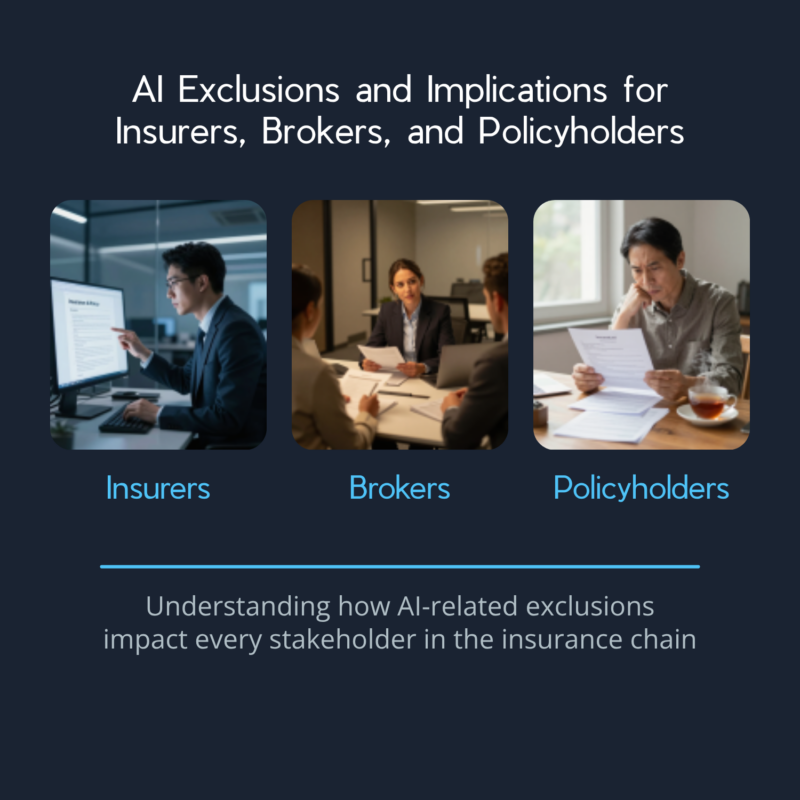
Graphic: AI Exclusions and Implications for Insurers, Brokers, and Policyholders - ai created image - mrh
Implications for Insurers, Brokers, and Policyholders
The introduction of these sweeping exclusions creates significant challenges and new responsibilities for everyone involved in the insurance process.
For Insurers and Underwriters
Underwriters face the difficult task of pricing risk in an environment where 1) there is no claim data to back up their decisions actuarially, and 2) they face a rapidly evolving technology that is largely uninsurable under standard policies. They must determine how to evaluate a company’s use of AI and how exclusions may apply to coverage. This will inevitably lead to more detailed underwriting questionnaires focused on a company’s use of and policies regarding AI. In the future, we may see specialized, and likely expensive, AI liability policies emerge, but for now, the primary trend is toward exclusion.
For Insurance Brokers
Brokers face a heightened risk of errors & omissions (E&O) claims arising from these exclusions. A broker’s duty, of course, depending on the state’s standard of care, is to advise clients on their risks and secure appropriate coverage. If a broker fails to explain the dramatic impact of these new AI exclusions clearly, they could be held liable when a client’s claim is unexpectedly denied. “Was a broader endorsement available?” the plaintiff attorney may ask in an E&O situation. Short of working with wholesalers who may have heightened knowledge of these exclusions, agents must carefully read forms and help their clients understand the effects of these exclusions. Proactive communication and diligent documentation will be essential for brokers to protect both their clients and their own firms.
For Policyholders
Ultimately, business owners and leaders will feel the most direct impact. The emerging use of AI impacts 95% of U.S. companies currently using it, according to Bain & Company.[i] Email editors, document generators, customer service chatbots, purchasing, HR software — Many employees use these tools not realizing that an AI is working behind the scenes. Policyholders must now re-evaluate their workflows to identify where they use AI and grasp that these activities may now be uninsured. This requires a new level of internal risk management and a critical review of reliance on AI-enabled platforms.
[i] https://www.bain.com/insights/survey-generative-ai-uptake-is-unprecedented-despite-roadblocks/#:~:text=At%20a%20Glance,in%20just%20over%20a%20year.
What’s Ahead?
When carriers roll out new exclusions, new markets inevitably open. One carrier offering a specialized product to cover generative AI liability is London coverholder Testudo. Their claim to “underwrite AI risk with a new category of insurance product” can be a first step toward providing alternative coverage. They state they built their product to address AI-related coverage gaps in the commercial general liability policy.
No doubt other insurers will follow suit.
Graphic: Understanding and Mitigating AI-related Liabilities - ai created image - mrh
Conclusion: Awareness is the First Step
As generative artificial intelligence continues to transform industries, it also introduces unique risks. These risks demand careful navigation. The rise of AI exclusions in insurance policies, particularly the sweeping changes introduced by ISO and individual carriers, marks a major shift in how businesses must rethink their risks.
Insurers, brokers and policyholders all face new challenges in understanding and mitigating AI-related liabilities. For businesses, this means rethinking workflows, enhancing internal risk assessments, and preparing for a future in which AI-driven activities may be without coverage under traditional policies. These exclusions will undoubtedly bleed into other lines of coverage, from directors’ and officers’ coverage to businessowners’ policies. According to a Verisk spokesperson, “Verisk anticipates filing similar exclusions for additional Lines of Business at a future date.” To date, Verisk has filed gen AI endorsements only for general liability and commercial umbrella/excess.
While these exclusions attempt to clarify insurer liability, they also underscore the need for innovation in crafting specialized AI liability solutions. In this rapidly evolving landscape, staying informed and proactive will be key to thriving in the age of AI.
Part Two will discuss the legal interpretation of AI exclusions, historical parallels, and explore the potential for coverage denials.
Need help with federal or state cases involving AI Exclusions in Insurance Policies claims?
Call 1 949 645-6842 for a complimentary 30 minute phone consult or email Robert Anderson today.