Fire Insurance Coverage Litigation After the Los Angeles Wildfires

By Robert M. Anderson, CPCU and Nancy Germond, MA, ARM
Post-wildfire insurance coverage litigation
This article offers insights and practical advice for both plaintiff and defense attorneys, claims managers and risk managers in the complexities of post-wildfire insurance coverage litigation.
The Los Angeles fires destroyed nearly 10,000 homes, causing long-lasting and unequaled crises for the families and business owners affected. According to a January 20, 2025, article from Artemis, 17,027 structures sustained damage or destruction.[1] Verisk estimates insured losses, including losses to the California Fair Plan, California’s insurer of last resort, at $28 billion to $35 billion.[2]
The FAIR Plan struggles with solvency. Its $3 million coverage cap often falls short of actual rebuilding expenses, leaving policyholders facing decisions on whether to rebuild or sell their property and relocate.
According to Insurance Journal, the FAIR Plan’s financial exposure increased by 61% between 2023 and 2024. Reinsurance deductibles and limited cash reserves additionally strains its ability to handle catastrophic claims, potentially leading to surcharges on property owners statewide.[3]
Additionally, news coverage points out the problems of underinsurance. Later in this paper, we’ll hear from John Putnam, an expert who assisted many homeowners after the 2021 Colorado Marshall fire. In that catastrophe, approximately three-quarters of those with damaged property were underinsured.[4] For underinsured or uninsured homeowners and business owners, the road to recovery is particularly formidable.
This may be especially concerning in Altadena, where many homes are generationally owned and bungalow or historic style. Called a “remarkable haven for generations of Black families….” Altadena may be forever “altered” as “recovery and rebuilding may be out of reach for many, and pressures of gentrification could be renewed,” according to an AP article.[5]
The Focus on Insurance Coverage
In the aftermath of similar catastrophes, understanding the intricacies of coverage, policy terms and regulatory obstacles can help you sidestep barriers to equitable outcomes, whether you advocate for policyholders or insurers. Hiring the right experts quickly, in part to prevent the best experts from opposing you, can mean better outcomes. Those experts with comprehensive property insurance knowledge can make all the difference in navigating these complex matters.
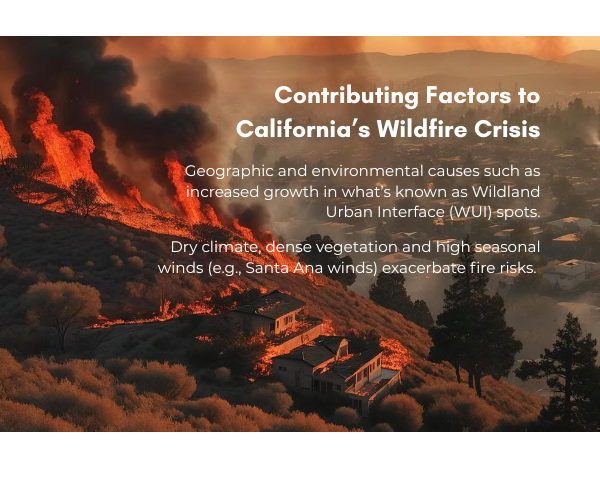
Contributing Factors to California’s Wildfire Crisis
Many factors impacted the wildfire crisis in California, including the following.
- Geographic and environmental causes such as increased growth in what’s known as Wildland Urban Interface (WUI) spots, the “zone of transition between unoccupied land and human development.[6] This includes hillsides, canyons and ravines that “merge with state’s forests, scrublands and grasses.”[7] Between 1990 and 2020, home builders located almost 45% of newly built homes in the WUI.[8]
- Dry climate, dense vegetation and high seasonal winds (e.g., Santa Ana winds) exacerbate fire risks.
- According to a Public Broadcasting program, of particular note is how urban planners and developers constructed homes and buildings in Pacific Palisades in patterns that allowed flames to flow along the line of the houses apparently without considering the prevailing Santa Ana winds.
California’s critical need for housing, with developments often extending into high-risk fire zones, increasing vulnerabilities.
- Rising global temperatures intensify the frequency and severity of wildfires.
- Historical and policy oversights, including the refusal by California’s Department of Insurance to approve property insurance rate increases sought by insurers.
- Delayed forest management has left many areas with excessive flammable debris.
As experts work with counsel to develop litigation strategies, they must understand the larger dynamic—many factors contributed to the wildfire catastrophe we watched unfold over the weeks and now months after the initial ignitions.
General Background on Insurance Regulatory Issues
Across the U.S., state departments of insurance (DOIs) regulate rates and protect policyholders. State DOIs attempt to protect consumers from excessive rates while balancing the need for fiscal solvency.
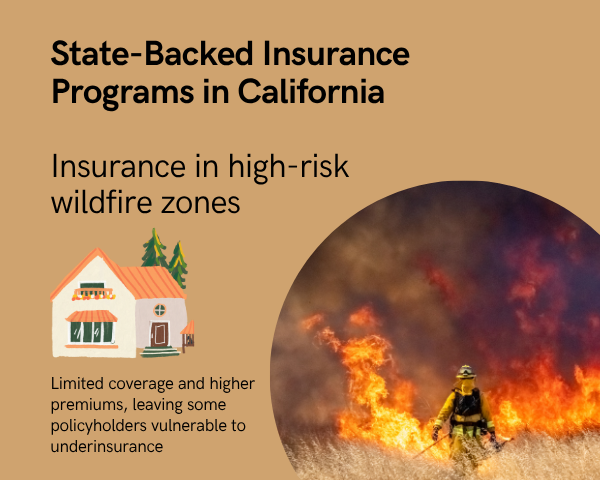
Expansion of State-Backed Insurance Programs in California
As private insurers increasingly withdrew from high-risk wildfire zones, state-backed programs stepped in to fill the gap. Programs like California’s FAIR Plan provide basic fire coverage for properties unable to obtain traditional insurance. However, these plans often offer limited coverage and higher premiums, leaving policyholders vulnerable to underinsurance.
- Many state-backed programs exclude additional living expenses (ALE) or only offer limited rebuilding costs, creating significant financial strain for impacted homeowners.
- There are limits to the coverage provided by the FAIR Plan. While it remains a backstop for high-risk properties, solvency concerns are now front and center. While California created the FAIR Plan to assure access to basic insurance, policy limits and coverage gaps will leave policyholders underinsured whose only option was this coverage.
- Post-disaster, the California Department of Insurance plays an important role in managing claims disputes and ensuring fairness in claims handling and coverage disputes.
- As an “insurer of last resort,” demand “skyrocketed” for dwellings in the last four years. As of September 2024, demand for dwelling coverage rose 61% from the previous year to $458 billion, triple the demand from only four years prior. For commercial properties, demand nearly doubled in one year to $26.6 billion and rose 464% in those same four years.[9]
After the fire, California’s DOI announced new regulations designed to encourage private insurers to resume writing new policies in fire-prone regions. New rules require insurers to write 85% of their market share in fire-prone areas. As a bone thrown to insurers, it appears, insurers are now able to factor in reinsurance costs to their rate calculations.[10] Reinsurance rates continue to rise as labor and raw materials rates rise and climate increasingly impacts reinsurance losses.
The Failure of Regulatory Action in Insurance Rate Management
Since voters enacted Proposition 103 in 1988, the California Department of Insurance sets insurance rates for most lines of property and casualty insurance. As early as 2023, then-Governor Newsom issued an emergency executive order attempting to stabilize the property market, which was “rapidly deteriorating,” according to the International Center for Law & Economics.[11] According to the Center, “…the Prop 103 rating system is slow, imprecise and inflexible relative to other jurisdiction….”
Interestingly, the paper alleges that “Contrary to claims that Prop 103 saved Californians as much as $154 billion in auto insurance premiums from 1989 to 2015, we find that Californians would have saved nearly $25 billion if they had not passed Prop 103.
Even before 2023, based on historic wildfire losses in the state, insurers began to retreat from writing property coverage in response to their inability to charge adequate rates, with some carriers leaving the state entirely. In 2023, according to Policy Genius, Safeco, Farmers, Allstate and State Farm took various steps to shrink their book of property business. California insurers paid $15.4 billion in 2017 losses and $13.6 billion in 2018 due to wildfires.[12] The California FAIR plan became the obvious answer for the many homeowners unable to find property coverage as the California DOI approved lower rate increases than increases requested by insurers. Add to the mix consumer groups like United Policyholders, the political implications of property coverage have only continued to grow to its current stalemate.
As for solvency, the FAIR Plan updated policyholders in February, assuring the public that the Plan “…continues to receive, manage and pay claims related to the Southern California wildfires….The latest estimates approximate the FAIR Plan has a total potential exposure of over $4 billion for the Palisades Fire and $775 million for the Eaten Fire.” It is currently accessing reinsurance to help pay claims.[13]
However, on February 11, the FAIR Plan notified admitted carriers of their duties regarding assessments. According to Insurance Journal, the state will assess those insurers $1 billion.[14] Up to 50% of these assessments can flow to policyholders.[15]
It seems clear that currently the municipalities and the State of California may be the “empty chair” in some fire-related litigation.

Central Issue: Fire Insurance Coverage Litigation Challenges
Insurance litigation after wildfires creates many challenges. Here are some primary areas of conflict policyholders, insurers and legal professionals encounter.
Many insurance experts whether agents or adjusters agree that the most important factor in property insurance coverage, whether personal or commercial, is correctly determining the building’s repair or rebuilding costs. Although the choice of a coverage limit is ultimately the insured’s, many E&O claims arise over the valuation and advice agents offered.
Inadequate Policy Limits
One major issue in wildfire-related insurance claims is the frequent underestimation of replacement costs. Insurers use proprietary software like 360Value from Verisk and RCT Express from CoreLogic, which often fail to account for real-world complexities such as labor shortages, material price surges and updated building codes. These software tools rely on outdated data and may use simplified calculations instead of detailed assessments.
Market incentives also play a role. Insurers aim to keep premiums competitive, which often leads to setting replacement cost limits lower than actual rebuilding expenses. Policyholders, looking to control costs, may also select lower coverage limits without fully understanding the risks. Further, insurers’ legal disclaimers shift responsibility for selecting coverage amounts to policyholders, limiting recourse when limits prove insufficient.
While agents warn their clients that these are estimates and that it is ultimately the client’s responsibility to develop the correct building replacement cost, limits may be insufficient. Even when agents verify warning in writing, they often face errors & omissions (E&O) allegations.
An Extended Replacement Cost (ERC) endorsement can help mitigate underinsurance by increasing the coverage limit beyond the dwelling’s stated value. Typically, ERC starts at 10% to 20% above the base amount, but it can be increased to 50% or even 100% at a relatively low additional premium. This added protection helps cover inflation, building code upgrades, and higher construction costs after a disaster.
Despite its affordability, many homeowners are unaware of the benefits of higher ERC limits. Reviewing policy options with an agent can ensure adequate protection and prevent financial hardship after a loss.
Even if policy limits appear adequate, post-disaster cost spikes—including labor shortages, permitting delays, and environmental remediation—can drastically inflate rebuilding costs. The result is widespread underinsurance, leaving many policyholders unable to recover fully after a wildfire.
Inadequate limits on commercial package policies, businessowners policies and business income coverage will also create litigation. In any widespread disaster, cleanup delays, lack of labor and materials and permitting issues slows recovery to a crawl. Endorsements are available on commercial property policies that provide extended periods of restoration to help pay for extended business interruption delays.
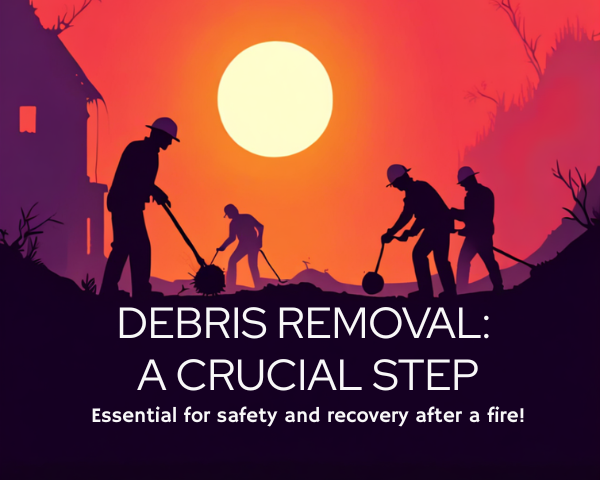
Debris Removal Issues
Coverage for debris removal, too, can be problematic. In a recent article by John Putnam, “Debris removal is a big deal.”[16] According to Putnam, “Debris is whatever solids remain after a fire.” However, he asserts that personal property debris leaves a residue of ash and metal with an unknown chemical makeup. Therefore, carcinogens such as asbestos require special remediation. Debris migration may impact structures still standing as well as surrounding water. Additionally, “Victims [want] an opportunity to bring closure to make sure any recoverable items are found,” Putnam points out.
Most personal policies allow additional coverage of 5% of the exhausted dwelling coverage for debris removal if the insured property was totally destroyed, according to Putnam. Some companies will also include Coverage B – Other Structures and Coverage C – Personal Property limits when arriving at a debris removal limit. There will be lower limits on trees and landscaping material. Personal property policies do not cover soil remediation.
Under commercial policies, debris removal has time limits and exclusions to property types covered by the policy. It usually limits coverage to $25,000 or another fixed amount if the “total debris removal amount exceeds 25% of the deductible plus the direct physical loss amount.”[17]
Vehicles require a different removal process. Coverage for vehicles that blocked firefighter access may also be litigated.
Foundations burn in many wildfires, and while homeowner’s policies typically cover foundations in the dwelling cost, commercial policies do not cover foundations unless endorsed. The common belief until wildfires became more frequent in the US is that foundations do not burn. However, in intense wildfires where heat may exceed 2,500 degrees, rebar in the foundation will expand and contract, degrading the foundation’s integrity.[18]
Remember, we’re discussing standard insurance policies, written by standard carriers. The reality is that many of these homes’ coverage probably now lies in surplus lines, where coverage will vary and usually be less robust than coverage offered on standard ISO-type policies written by admitted carriers. Watch for litigation arising from failure to explain those coverage variations when agents moved their insureds to surplus lines carriers after non-renewal by standard carriers. According to Putnam, FAIR Plan policies do not offer additional debris removal coverage, “…so any debris removal costs will be deducted from the policy amount purchased.”[19]
While the Federal Emergency Management Agency may offer public assistance for debris removal[20], the new administration may be reluctant to expend much help to a decidedly blue state.
The impacts of increasing construction costs, supply chain disruptions and labor shortages will increase rebuilding costs and create construction delays. Many if not most policyholders face underinsurance challenges due to outdated limits that fail to reflect rising rebuilding costs, with one estimate as high as 75%.
Other Coverages Will Generate E&O Claims
We anticipate many E&O claims will allege that the coverage offered by the agent did not meet the insured’s needs.
Next, the issue will be endorsements. Which endorsements that provide additional coverage or increased limits could have prevented underinsurance issues?
Code Delays, Additional Living Expenses and Upgrades
Mandatory code upgrades, scarce resources and stricter fire-resistant building requirements often delay reconstruction timelines and increase costs.
- Code upgrades may include installing sprinkler systems, upgrading to fire-resistant materials, American with Disability Act (ADA) requirements in commercial buildings and defensible space mandates. These upgrades will delay rebuilding and increase costs.
- Delays will spark disputes over policy terms and additional living expenses (ALE) payments due to rising rental costs. The displaced now encounter limited availability as well as more costly housing.
- While catastrophe adjusters will continue to flow into California, the lack of property adjusting talent will create additional hurdles. The demand for experienced adjusters often outstrips supply after large-scale disasters, compounding delays, increasing unfair or uninformed coverage decisions and other disputes.
- Simply because a home survived while its neighboring homes burned, wildfires often cause toxic smoke and soot to infiltrate homes left standing. This soot can damage HVAC systems, insulation, wiring and even building materials such as wood or brick.[21]
According to one insurance coverage expert, “I’m forecasting the next significant wave of insurance litigation: smoke damage claims under homeowners and commercial property insurance policies.” He focused on these three issues.
- To what extent does smoke infiltrate tangible property (walls, carpets, HVAC systems)?
- Can smoke-related contaminants (e.g., volatile organic compounds) be safely and fully removed, or do they render property hazardous and uninhabitable?
- What cleaning and remediation methods are proper and necessary?
He says that as smoke damage claims emerge, insurers and policyholders will clash over what qualifies as ‘physical,’ whether smoke can be cleaned, and the cost of proper remediation.
Adjusting Missteps in Fire Insurance Coverage Litigation May Increase Litigation and Regulatory Scrutiny
California has stringent claims handling guidelines in its Fair Claims Settlement Practices regulation. In January 2025, it either published or updated its “Guide for Adjusting Property Claims in California After a Major Disaster”[22]
Some of the provisions include the following.
- For a claim under a residential property, after a declared state of emergency, insurers must provide a policy no later than 15 calendar days from the insurer’s claim notice. For insurers covered by California Insurance Code Section 2071 (those carriers that write fire insurance), the insurer must provide a `free copy of the policy, its endorsements and the declarations page.
- There are various requirements regarding additional living expenses, time extensions and the timing of insurers payments.
- If the insured requests it, insurers must advance additional living expenses of no less than four months.
- There are various restrictions on the forms and grouping of contents for personal property damaged in the event.
- There are various time limits to respond to claimant communications.
- There are definitions of actual cash valuation and replacement cost valuation.
- There are rules regarding the insured’s ability to rebuild at another location or rebuild at the same location.
Adjusters who are unfamiliar with these regulations may face regulatory scrutiny. Out-of-state or less experienced adjusters unfamiliar with California’s regulatory claims-handling requirements may miss important deadlines.
Practical Steps and Considerations for Policyholders and Insurers
- Precise Documentation: Detailed, accurate records of losses and claim interactions can expedite resolutions.
- Policy Reviews: Regularly updated policies to ensure alignment with current rebuilding costs and code requirements.
- Leverage Appraisal Provisions: Utilize alternative dispute resolution methods like mediated appraisals to avoid prolonged legal battles.
Creating More Favorable Litigation Outcomes
Addressing the complex challenges of defending or prosecuting wildfire claims requires a nuanced approach that integrates technology such as photo imagery, innovative litigation tactics and the best expert assistance available.

Smartly Navigating Fire Insurance Coverage Litigation
Both plaintiff and defense counsel should retain property experts early to accurately assess damages, coverage, claims handling procedures and practices. Experts with a balanced perspective (neither solely plaintiff-directed nor insurer-biased) help to reduce accusations of bias and avoid litigation missteps.
Here are some suggestions to consider when selecting an expert witness.
- Ensure that your expert is fully versed in property coverage. Some experts are stronger on liability issues and weaker on property coverages. Your expert should have years of experience in property coverage analysis.
- Your expert should understand the difficulties property owners face when they find there are inadequate limits or property gaps that stronger endorsements or agent advice could have resolved.
- Your expert should be coachable. An expert with an air of superiority or overconfidence may resist advice and talk over the heads of the jurors. Since most claims settle short of litigation, many experts have deposition experience but little trial experience. Evaluate the trial experience of experts before engaging them.
- As mentioned earlier, discuss engagement with experts you don’t want opposing you.
- Your experts must be likable to the jury. If your expert uses acronyms, speaks over the jury’s head or appears condescending, juries may not find them credible and persuasive. Jury members must find the experts relatable to some extent, and highly credible. Yet while likability is important, the expert’s knowledge and qualifications are the most important elements in choosing the right expert.
- Look for those empty chairs not brought into the fire insurance coverage litigation as discussed earlier.
- With virtually every Los Angeleno impacted by the wildfire whether themselves, their relatives, or their coworkers, voir dire questions and answers will be critical.
For Plaintiff Attorneys Prosecuting Fire Insurance Coverage Litigation
- Focus on demonstrating coverage deficiency damages such as insufficient limits, ALE disputes and lack of enough coverage for code upgrade compliance.
- Highlight policyholders’ dependency on brokers for understanding coverage adequacy.
- Don’t simply rely on the reptile theory. Although damage is widespread and impacted many, you must have a clear litigation story that defines the problems faced by your client and why they were somewhat unique.
- Consider visuals, “a day in the life” before and after the fire, and other tech tools to bolster your case. For families impacted, focus on the disruption to children, such as changing schools midterm and losing sports participation.
- Focus on claims handling. Did the carrier live up to its internal claims handling guidelines?
For Defense Attorneys Defending Fire Insurance Coverage Litigation
- Defend insurers by emphasizing the difficulties of adjusting claims in a catastrophe.
- Don’t skirt around the fact that insurance consumers have a duty to read their policies and choose adequate insurance limits. Look for all documentation in the agency’s management system or file to help defend what the agent told the insured about the insured’s responsibility in choosing coverage amounts and reading their policies.
- Mitigate bad faith claims exposure by justifying delays due to lack of labor, lengthy inspection timelines, or regulatory factors.
- Both sides in fire insurance coverage litigation may benefit from the appraisal process to sidestep court proceedings. However, the plaintiff bar may use this to their advantage. Invoking this policy clause allows neutral appraisers to help determine the claim value, saving both time and litigation.
- When defending agents review the responsibilities of wholesale underwriters to see if they performed according to their standards. In California, there is “no duty to advise absent a special relationship” according to the book by the Hasset Glaser law firm, “Insurance Producers’ Duty to Advise.” Producers “…owe a limited duty to use reasonable care, diligence and judgment when procuring insurance requested by the insured.”
- Continue to urge the insured in writing to cooperate and furnish the requested documentation. Highlight any deficiencies in the insured’s cooperation and documentation if that failure caused delays. Remember, however, in many of the fires, all documentation may have burned.
- Expect and prepare to defend bad faith allegations and demands for punitive damages.
Conclusion of Fire Insurance Coverage Litigation
The Los Angeles wildfires are a solemn reminder of why property coverage adequacy, policy provisions and speedy and compassionate claims handling must be at the forefront of the insurers’ responses. Fire insurance coverage litigation will only grow as wildfires intensify, bringing new case law and complexities to policy enforcement and legal disputes.
For attorneys, insurers, and property experts alike, navigating this landscape requires innovation, collaboration with strong experts and a commitment to equitable recovery for all parties involved. Early action and expert involvement are critical for avoiding contentious litigation and ensuring smoother recoveries.
With housing and labor shortages predicted, policyholders are ill-equipped to encounter delays in wildfire claims processes. Litigation arising out of these wildfires will undoubtedly produce frameworks to litigating future wildfire claims.
Although the author in an “Adjusters International” article referred to low liability limits, the same thought applies to the anticipated fire insurance coverage litigation in Los Angeles. “Public sentiment does not pay the bills for people who have suffered losses who are not fully insured on their own.” This theme will frequently repeat itself in the aftermath of the California wildfires.
Juries hear facts; however, they often rule on emotions. As they hear the evidence, they may ask themselves, “What if I or my family were in this situation?” This is the dilemma the defense side will face on the underinsurance and coverage issues they will litigate.
Quickly retaining the best expert witnesses available in fire insurance coverage litigation can help both sides overcome the evidence burdens they will face.
Need help with federal or state cases involving Fire Insurance claims?
Call 1 949 645-6842 for a complimentary 30 minute phone consult or email Robert Anderson today.
Footnotes:
- https://www.artemis.bm/news/la-wildfires-17027-structures-damaged-or-destroyed-insured-loss-estimates-avg-32-5bn/#:~:text=Insured%20loss%20estimates%20avg%20%2432.5bn,-20th%20January%202025&text=According%20to%20the%20latest%20official,risk%20modellers%20average%20%2432.5%20billion.
- https://www.verisk.com/company/newsroom/verisk-estimates-industry-insured-losses-for-the-palisades-and-eaton-fires-will-fall-between-usd-28-billion-and-usd-35-billion/
- Will California’s FAIR Plan Have Enough Cash for Its Wildfire Claims?
- https://www.cbsnews.com/news/la-fires-insurance-rebuilding-cost/
- https://apnews.com/article/california-wildfire-pacific-palisades-pasadena-altadena-inequality-63ea76d186740359f7f5dd188896354f
- https://www.usfa.fema.gov/wui/what-is-the-wui.html
- https://calmatters.org/housing/2025/01/ca-wui-housing-policy/
- https://calmatters.org/housing/2025/01/ca-wui-housing-policy/
- https://www.cnn.com/2025/01/09/business/california-wildfires-homeowners-insurance/index.html#:~:text=To%20give%20California%20homeowners%20in,lumber%20and%20other%20raw%20materials.
- Ibid
- https://laweconcenter.org/resources/rethinking-prop-103s-approach-to-insurance-regulation/
- https://www.policygenius.com/homeowners-insurance/news/california-wildfires-insurance-crisis/
- https://www.cfpnet.com/update-from-the-california-fair-plan-5/
- https://www.insurancejournal.com/news/west/2025/02/11/811676.htm
- https://insurify.com/homeowners-insurance/news/ca-oks-rescue-assessment-for-fair-plan/
- Wildfire Recovery: The Critical Role of Debris Removal Coverage
- Ibid
- Ibid.
- Ibid
- PA Fact Sheet: Private Property Debris Removal (2019)
- Wildfire Smoke Claims: A Hidden Postwildfire Catastrophe https://www.irmi.com/articles/expert-commentary/wildfire-smoke-claims-a-hidden-postwildfire-catastrophe
- https://www.insurance.ca.gov/0200-industry/0050-renew-license/0200-requirements/upload/2025GuideAdjstPropClaimsinCA-After-a-Major-Disaster.pdf