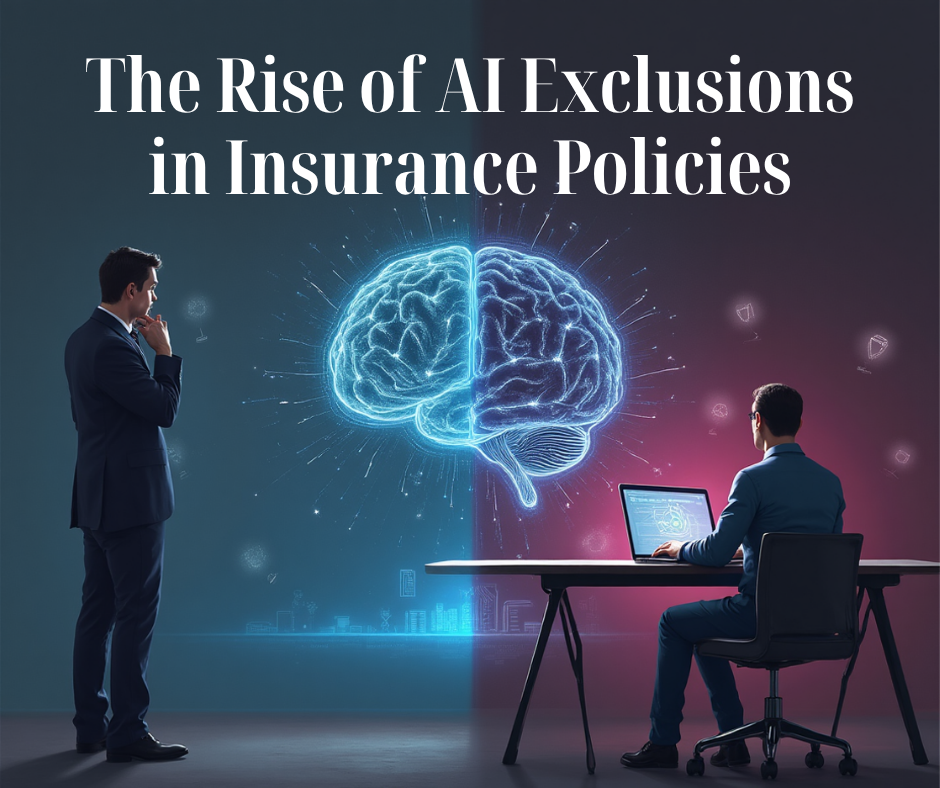
Understanding the Historical and Legal Context of Generative AI Coverage Exclusions
As mentioned in (part one) in this series about The Rise of AI Coverage Exclusions, this article (part two) discusses the legal context of generative AI coverage exclusions, legal interpretation of AI exclusions, historical parallels, and explores the potential for coverage denials.
Introduction
Artificial intelligence is reshaping how companies operate, both in the U.S. and around the world. This enthusiastic embrace of generative AI significantly expands an organization’s risk environment. In turn, this adoption has compelled the insurance industry, especially its advisory organizations, to reassess the risk associated with AI in their daily operations. Continue to read more about the legal context of generative AI coverage exclusions.
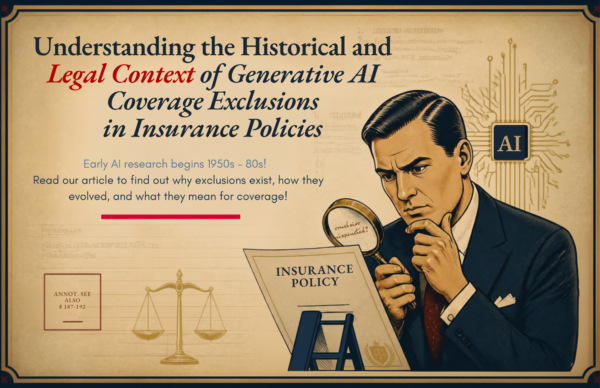
Legal Context of Generative AI Coverage Exclusions – ai created Graphic - mrh
Verisk (formerly Insurance Services Office) and insurers have responded by drafting specific AI exclusions to limit their financial exposure. For insurance agents, brokers, underwriters and expert witnesses, simply reading liability policy language is no longer enough. To grasp the implications of these changes, you must understand the legal and historical context of such exclusions.
Understanding the critical details of AI insurance exclusions is essential for protecting your clients from devastating financial gaps. This article reviews the legal and historical forces shaping these emerging exclusions. We will examine how courts interpret similar policy language and analyze historical patterns in the insurance market. Through this comprehensive analysis, you will better recognize the escalating risk of potential coverage denials and implement strategic protection measures that better protect organizations’ interests.
Graphic: Insurance Contract Legal Language - ai created image - mrh
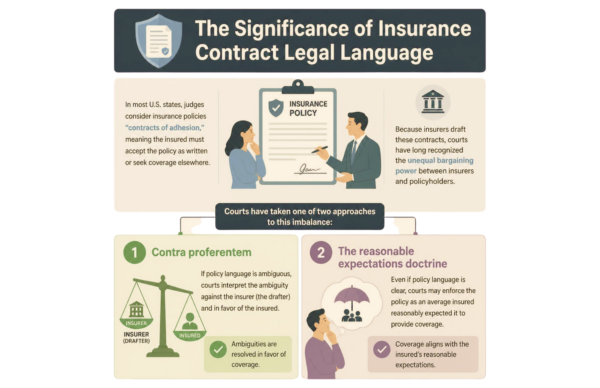
The Significance of Insurance Contract Legal Language
In most U.S. states, judges consider insurance policies “contracts of adhesion,” meaning the insured must accept the policy as written or seek coverage elsewhere. Because insurers draft these contracts, courts have long recognized the unequal bargaining power between insurers and policyholders.
Courts have taken one of two approaches to this imbalance:
- Contra proferentem
- The reasonable expectations doctrine
Contra proferentem does not consider any extrinsic or parol evidence, such as oral or written communications between parties, when interpreting ambiguous terms. This law may be why underwriters are so often reluctant to answer coverage questions.
Courts that apply the reasonable expectations doctrine view the policyholder’s expectations of coverage much more broadly. Where there is ambiguity in the contract and courts cannot determine the “mutual intent” of both parties, the courts may consider what a reasonable person would have thought the word or phrase meant.[1]
As with any new exclusions, how courts interpret these exclusions will soon become case law. With generative AI exclusions, wording will become important in parsing cases. However, how practitioners use AI will matter, as well.
Will Minimal AI Involvement Trigger the Generative AI Exclusion?
Consider this example.
An insurance broker sells a commercial general liability policy with a generative AI exclusion to an association that uses generative AI to develop recreational outings for its annual meeting in Nashville. AI suggests the Grand Ole Opry as a place the meeting attendees “should not miss.” The insured then uses this recommendation for its attendees. However, during a nighttime outing to that venue, a mass casualty event occurs. Serious injuries occurred to two of the association’s attendees.
How will the courts interpret this use? Would the association’s reliance on generative AI to develop its agenda mean the carrier could deny this claim?
Some Insurers’ Broad Exclusions – Legal Context of Generative AI Coverage Exclusions
In response to threats associated with generative AI, the W.R. Berkley Corporation designed a new broadly worded “absolute” exclusion for use in the carrier’s D&O, E&O, and fiduciary liability policies. The exclusion applies to “…any actual or alleged use, deployment, or development of artificial intelligence by any person or entity…”[2] How courts will interpret this broad exclusion may hinge, according to one insurance blog, on the policy’s definition of “artificial intelligence.” This blog describes the development of this absolute exclusion as “an important development in how the insurance industry is navigating the complexities associated with AI.”[3]
Graphic: The Three Most Litigated Words — “Arising Out Of”- ai created image-mrh
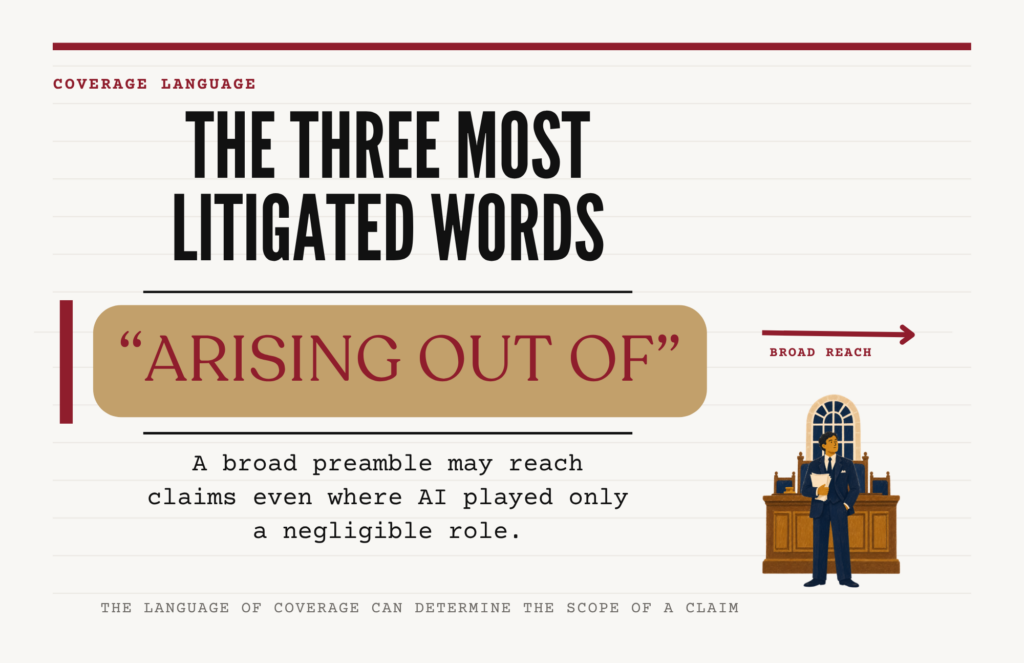
The Three Most Litigated Words — “Arising Out Of”
While, to date, most of the generative AI exclusions focus on general liability policies, there is no doubt these exclusions will extend to professional lines of coverage. Employment practices liability insurance (EPLI), directors and officers coverage (D&O), and errors and omissions (E&O) coverage will see carriers, including advisory organization Verisk, add gen AI exclusions to these and other lines of coverage.
In agents’ E&O, Utica Insurance has already filed a gen AI exclusion; however, Swiss Re, another of the largest carriers offering insurance agents’ E&O, has not.
There are different “types” of exclusions, and the absolute AI exclusion favored by Berkley Companies is the broadest type. According to Harvard Law, the absolute exclusion will bar any claim “…based upon, attributable to, arising out of, or related to, in whole, or in part, any use of artificial intelligence, including but not limited to:
- Errors, omissions, or inaccuracies in the programming, functioning, or the decision-making processes of artificial intelligence systems
- Bodily injury, property damage, or economic loss caused by, or resulting from, the actions or decisions of artificial intelligence systems
- Claims related to data breaches, privacy violations, or cyber incidents caused by the use of artificial intelligence systems.”[4]
Harvard Law reiterates in its article, “This exclusion applies to any party, including but not limited to non-insured parties, an insured, their employees, agents, contractors, or any third parties using artificial intelligence on the insured’s behalf.”
The article warns, and many professional liability experts agree, “The broad preamble to this exclusion, including coverage for claims ‘based upon, attributable to, arising out of, or related to, in whole, or in part,’ is incredibly broad and insurers may use them to exclude coverage for claims even where AI only played a negligible role in the wrongful act or error at issue in this claim.”
Clearly, agents should carefully read any exclusionary language, not simply assume the carrier uses ISO’s less restrictive exclusionary language.
Graphic: Definitions Matter- ai created image - mrh
Legal Context of Generative AI Coverage Exclusions Definitions Matter
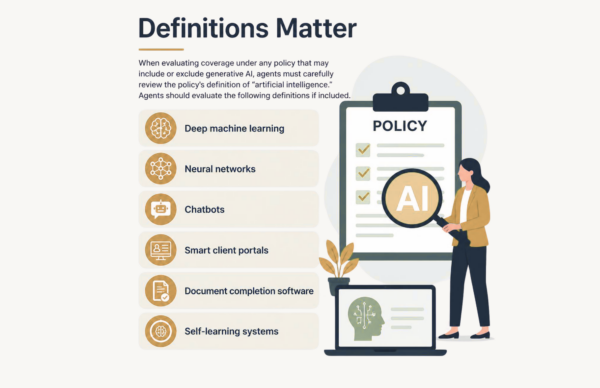
When evaluating coverage under any policy that may include or exclude generative AI, agents must carefully review the policy’s definition of “artificial intelligence.” Agents should evaluate the following definitions if included.
- Deep machine learning
- Neural networks
- Chatbots
- Smart client portals
- Document completion software
- Self-learning systems
Finally, does your insured understand which automated systems fit the above definitions?
Clearly, definitions matter and the agent must understand how those definitions can impact the policyholder.
Contractual Shifts Are Needed to Hold AI Vendors Accountable
A Risk & Insurance article points out “…a structural imbalance in how liability is allocated between AI vendors and the enterprises that use their tools.” To date, courts and regulators view AI not as a potential codefendant, but simply as a tool. They expect that the user, the deploying organization, is responsible for any issues such as hallucinations or copyright infringement.[5]
Contracts with AI vendors favor the vendor, not the organization using the product. Contracts usually cap liability at one year of fees and do not guarantee the product’s performance.
New and targeted risk management measures surrounding contract negotiations and governance will be required, as further addressed in Part 3.
Insurers fear they may face “accumulation risk,” the potential for widespread losses from a single event—for example, a wave of intellectual property litigation.
Graphic: Current Generative AI Litigation - ai created image - mrh
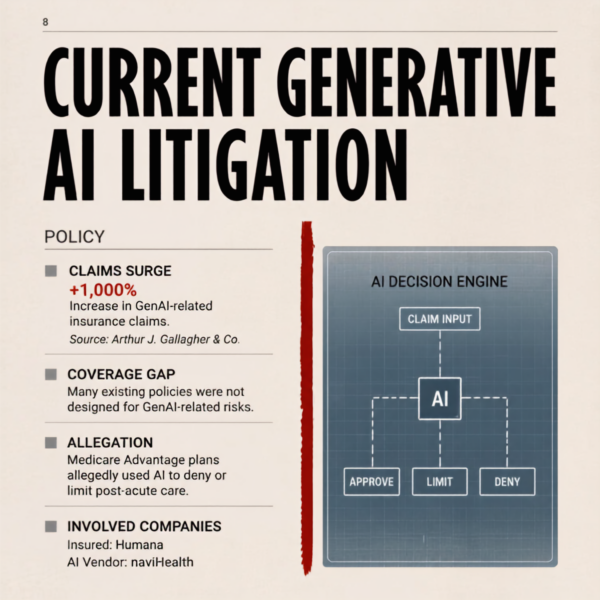
Current Generative AI Litigation
According to Risk & Insurance, gen AI-related claims have risen by almost 1,000% since 2021. Furthermore, the report referenced in its article mapped “coverage gaps across every major policy line.”[6]
In one widely followed claim, class members succeeded in filing suit against UnitedHealth Group (UHG), alleging UHG allowed AI programs, rather than medical professionals, to deny claims in Medicare Advantage plans.[7] In addition, both Cigna Healthcare and Humana faced similar claims.
While these claims so far center on healthcare decisions, gen AI exclusions are so new that case law will continue to evolve. This inevitable evolution makes managing this risk difficult. Even with the best alternative insurance coverage, a November 2025 article by INSTECH experts recommends the following.
“…it matters less whether AI risks eventually sit within existing policy lines, emerge as embedded features, or evolve into a new, standalone class of AI insurance. What matters is that AI risks are material and growing, creating significant exposure to portfolios and businesses alike.”
The authors go on to say, “As such, they must be rigorously understood, quantified, and managed. Businesses adopting AI will need confidence that, when failures occur, clearly defined insurance coverage stands behind the technology if they decide to transfer the risk into the market.”
Graphic: Making Generative AI Insurable - ai created image - mrh
Areas to Watch – Legal Context of Generative AI Coverage Exclusions
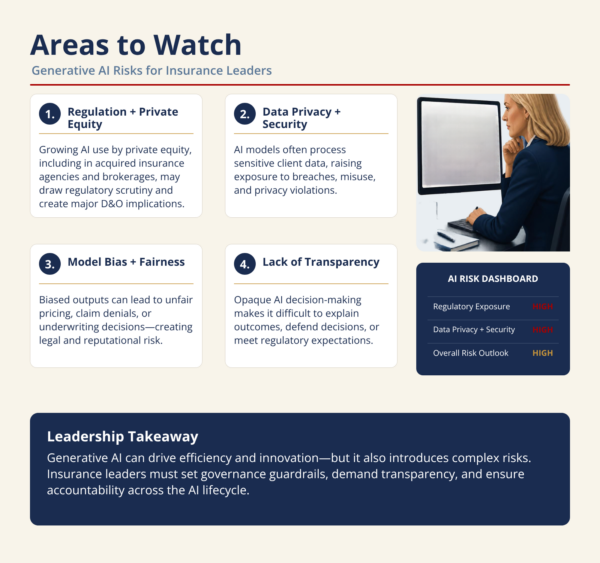
Regulatory bodies such as the Securities and Exchange Commission may closely watch private equity’s growing use of AI. Because private equity firms are still actively acquiring insurance agencies and brokerages, this is one area to watch as AI use grows, perhaps largely driven by the desire to eliminate headcount. This could have major implications for D&O coverage.[9]
Additionally, insurance coverage experts predict an influx of intellectual property claims as large language models scrape and collect critical proprietary information. Personally identifiable information may be at risk, as well.
There is a great deal of environmental concern about data centers, as well. From water consumption to carbon emissions to broader climate concerns, these risks will also generate issues that go far beyond the gen AI exclusions themselves.
Hallucinations in AI, where the system generates wrong or misleading information, abound. Part of reducing these mistakes can come from better training for operators of gen AI, including more targeted prompts and increased verification of where the AI model derived its reply. Are these sources reliable? Are they updated, preferably within the past few years?
These are just a few of the challenges of generative AI use for insurance organizations’ leadership to examine.
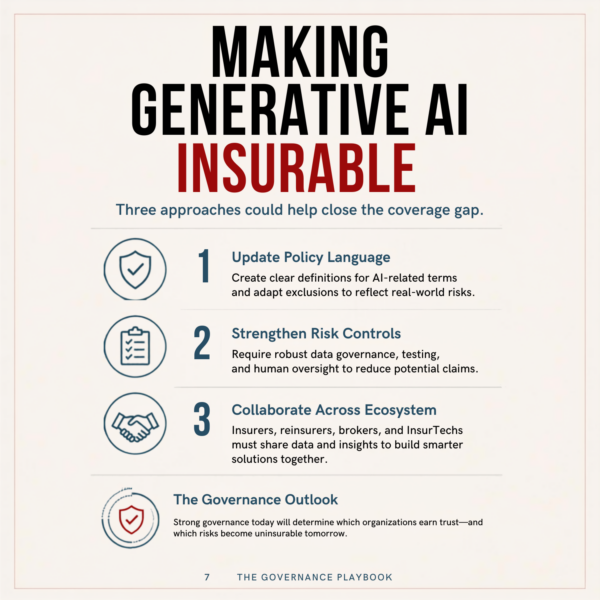
They recommend the following to make AI insurable:
- Performance-based guarantees should apply if AI underperforms. The authors remind us that the losses we will see from gen AI will not fit “neatly” into existing coverages such as cyber and D&O. This “silent coverage” has created uncertainty for insurers that no doubt helped create the current exclusionary language.
- Usage-based insurance that scales with AI activity, perhaps per call, per decision, etc.
- Premium differentiation, such as we see in certain cyber policies. “Safer systems should cost less to insure.”[8]
Because gen AI adoption is so rapid and governance is still developing, our next article will focus closely on governance. Future governance failures and gen AI coverage declinations are where the next waves of litigation will arise. Carriers, attorneys defending and prosecuting these claims, as well as expert witnesses who will opine regarding coverage and governance, should watch these arenas closely.
Graphic: areas of generative AI use for insurance organizations’ leadership to watch - ai created image - mrh
Graphic: Challenges of Managing AI - a Rapidly Evolving Business Tool - ai created image - mrh
The Challenges of Managing a Rapidly Evolving Business Tool
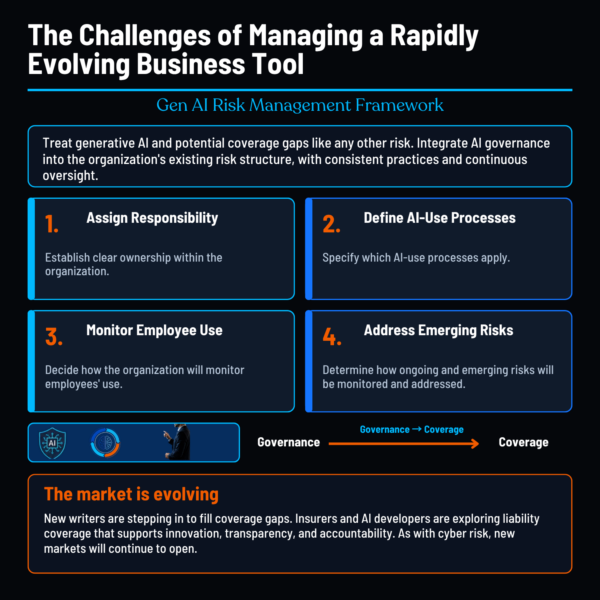
Businesses must treat the use of generative AI — and the potential lack of coverage for it — as they would any other risk: through a risk management framework. Gen AI governance should never operate in isolation from the organization’s existing risk structure. Instead, organizations must build a framework that turns broad principles into consistent practices with continuous oversight.
A strong framework should:
- Assign responsibility within the organization
- Define which AI-use processes apply
- Decide how the organization will monitor employees’ use
- Determine how the organization monitors and addresses ongoing and emerging risks
Several new writers have stepped in to fill coverage gaps. One insurer is partnering with an AI developer to co-develop liability insurance that “not only recognizes the complexities of AI underperformance but provides meaningful coverage that supports innovation, transparency, and accountability.” As insurers respond to a coverage gap, as they did with cyber risk, new markets will continue to open.
The next article (part 3) will focus on practical governance strategies for managing generative AI risk. Strong governance will be essential to reducing litigation exposure and avoiding future coverage disputes.
Need help with federal or state cases involving AI Exclusions in Insurance Policies claims?
Call 1 949 645-6842 for a complimentary 30 minute phone consult or email Robert Anderson today.
References: